
A hospital bed has to do more than look clinical. It needs to fit the room, support the intended user, and make caregiving tasks manageable without turning every adjustment into a complicated process. I focused on models suited to home recovery, long-term support, and specialized care, with special attention to adjustment ranges, mattress size, mobility, safety rails, and included caregiving accessories.
The eight options below range from compact three-function beds to wide, multi-function frames built around demanding care needs. Some prioritize straightforward positioning, while others add lateral turning, built-in commode support, or a broader choice of sleeping dimensions.
The Leading Options At A Glance

VEICAR Full Electric Hospital Bed with Lateral Turning, CPR Flat, Bedpan
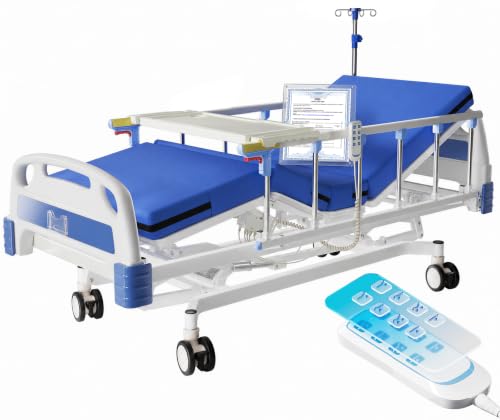
HaiyoHBED 4 Function 600 lbs Full Electric Hospital Bed

RESTISLAND Electric 3 Function Hospital Bed with IV Pole, Mattress

Fuzren 5 Function Full Electric Hospital Bed with Mattress

Medacure Ultra Wide Adjustable Hospital Bed with 48-inch Foam Mattress, 8 Functions
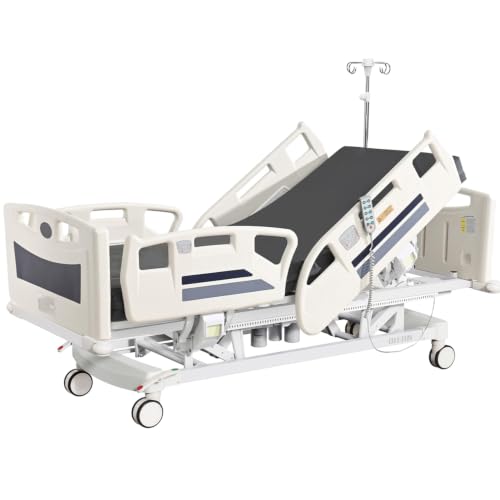
OLERN Premium 5 Function Hospital Bed

OLERN 5 Function Full Electric Hospital Bed

OLERN 3 Function Full Electric Hospital Bed
A Breakdown Of The Leading Choices
At a glance, the VEICAR bed looks like the most caregiver-oriented frame in this group, largely because the positioning controls extend well beyond a basic backrest. In a home where a person spends extended periods in bed, the powered lateral turning cycles can reduce repeated manual repositioning, while the 550-pound capacity gives the frame a sturdy starting point.
Unlike the simpler models later in this roundup, this bed combines a backrest adjustment up to 70 degrees, knee lift up to 20 degrees, leg lowering to negative 65 degrees, and side turning up to 45 degrees. I see the strongest fit for households that need frequent repositioning and have room for a full bedside-care setup, although that larger feature set may be more than a short recovery requires.
Where It Delivers
- Timed 30- and 45-minute lateral cycles support regular repositioning without constant manual effort.
- Independent back, knee, and leg controls create several useful resting and care positions.
- The built-in commode, shampoo basin, IV pole, and movable table reduce the need for separate accessories.
- Manual backup operation keeps essential adjustments available during a power interruption.
Things To Consider
- The extensive accessory package calls for careful room planning and more setup than a basic bed.
- Caregivers should confirm that the powered movement ranges suit the intended occupant and care routine.
Key Specs
Built With In Mind
This model suits caregivers managing long periods of bed rest with frequent assisted repositioning.
A Better Fit Elsewhere
RESTISLAND Electric 3 Function Hospital Bed with IV Pole, Mattress offers a simpler setup for straightforward recovery and everyday positioning.
The HaiyoHBED frame takes a more restrained approach than the VEICAR bed, focusing on four electric functions and a stated 600-pound capacity. That combination makes it relevant for larger adults or households seeking additional load capacity without the lateral-turning hardware and broad accessory bundle found in the first model.
I would consider this for a dedicated bedroom or care room where adjustable backrest, leg support, height, and tilt functions cover common positioning needs. Compared with the Fuzren model reviewed later, it offers a higher stated capacity but fewer listed functions, so the deciding factor may be occupant size rather than the longest feature list.
Good Reasons To Consider
- The 600-pound capacity gives it the highest stated load figure in this roundup.
- Four independently adjustable functions provide useful options for sitting, resting, and care.
- Full-electric operation removes the need for manual crank-style positioning.
- The included IV pole and mattress make the basic care setup more complete.
Worth Noting
- The bed has fewer listed functions than the Fuzren, OLERN five-function, and Medacure eight-function models.
- Room dimensions and doorway access should be checked before ordering a frame with a broad care footprint.
The Right Fit
This option fits larger occupants and caregivers who prioritize load capacity with four essential electric adjustments.
Another Choice May Suit
Fuzren 5 Function Full Electric Hospital Bed with Mattress suits households that prioritize more positioning controls and a broad backrest range over the highest stated capacity.
Three functions can be plenty when the priority is familiar positioning rather than an extensive control panel. The RESTISLAND bed raises the head and back from flat to 80 degrees, adjusts the knee section from 0 to 45 degrees, and changes the bed height between 16.3 and 28.3 inches.
That combination fits a home recovery scenario where sitting up, eating, and raising the frame for caregiving are routine tasks. Unlike the OLERN five-function models later in the list, this frame keeps the controls focused on the three movements most families use most often, with a 530-pound stated loading capacity.
Benefits That Matter
- The remote-controlled bed reduces the effort required for common positioning changes.
- A 12-inch height range gives caregivers room to work at different heights.
- The included IV pole, foam mattress, dining table, and sheets cover several immediate care needs.
- Five-inch locking casters support movement when the bed needs repositioning.
Small Caveats
- Only three adjustment functions are offered, so specialized tilt or turning is outside its basic positioning range.
- The stated 530-pound capacity is lower than the 550- and 600-pound figures on several alternatives.
Feature Snapshot
Made For
This model suits home recovery patients who need electric backrest, knee, and height changes without a large accessory package.
Reach For A Different Pick When
OLERN 3 Function Full Electric Hospital Bed suits shoppers who want a similar adjustment count but a larger stated capacity.
The Fuzren bed expands on the RESTISLAND model by adding two tilt-oriented functions and a central locking system. Its backrest reaches 80 degrees, the leg section rises to 45 degrees, and the overall height adjusts from 17.72 to 29.52 inches. For a home care room, that creates a useful balance between upright rest, leg support, caregiver access, and specialized positioning.
Trendelenburg refers to a head-down tilt, while reverse Trendelenburg places the head higher than the feet. This bed supports both directions with up to 14 degrees of tilt, which may suit caregivers familiar with those clinical positions, although the central locking system is the feature I would examine most closely before final placement.
Points In Its Favor
- Five functions expand beyond ordinary backrest, legrest, and height adjustment.
- A 16-degree backrest range helps create an upright resting position.
- Bidirectional tilt adds positioning choices for specialized caregiving.
- The included 4.7-inch foam mattress and sheets simplify initial setup.
Points To Keep In Mind
- The central locking arrangement needs a clear path for locking and releasing all casters.
- Its five functions add complexity compared with a straightforward three-function frame.
Technical Highlights
Who Will Love This
This model suits caregivers who regularly use tilt positions and want more control than a standard three-function electric bed.
Where Another Pick Shines
HaiyoHBED 4 Function 600 lbs Full Electric Hospital Bed fits larger occupants who prefer a higher stated capacity and fewer controls.
Frame dimensions become decisive when a standard-width bed cannot provide enough sleeping space or room for a caregiver to work. The Medacure model answers that problem with adjustable widths of 36, 42, or 48 inches, an adjustable length from 80 to 88 inches, and a height range from 14 to 30 inches.
Its eight-function hand pendant adds a wider control set than the Fuzren bed, but the real distinction is the frame’s ability to change dimensions. I would consider this for bariatric care or a spacious home-care setup, with the 48-inch configuration offering the largest included foam mattress. The tool-less frame adjustment simplifies resizing, though the final footprint needs to be measured in the intended room.
Features That Help
- Three width choices let the sleeping surface adapt to occupant and caregiver needs.
- An adjustable length offers more flexibility than a fixed 80-inch frame.
- The low setting of 14 inches can assist with safer access to the sleeping surface.
- Eight hand-pendant functions provide broad positioning control.
Practical Considerations
- The largest width and length configuration needs substantial floor space and turning room.
- The 48-inch mattress is included, while 36- and 42-inch foam options are also listed.
Right Fit For
This model suits caregivers serving a larger occupant or needing adjustable frame dimensions in a spacious care room.
Not Your Match When
RESTISLAND Electric 3 Function Hospital Bed with IV Pole, Mattress is the easier fit for compact rooms with standard positioning needs.
The narrower sleeping surface makes this OLERN model worth a close look for rooms that cannot accommodate the Medacure bed’s expanded dimensions. Its sleeping area measures 78.7 by 33.5 inches, while the complete frame spans 83.5 by 41.3 inches and adjusts from 17.7 to 29.5 inches in height. The footprint remains substantial, but it is more conventional than a 48-inch-wide bariatric configuration.
I appreciate the four collapsible wing-style side rails because each section can fold independently when access is needed. That arrangement is more flexible than a fixed rail, and the five electric functions make this a well-rounded option for home recovery and ongoing care.
What Pays Off
- Five electric functions support a broad set of resting and care positions.
- Four collapsible rails provide adaptable side support.
- The 550-pound capacity suits a wide range of home-care scenarios.
- Height adjustment offers practical access for caregiving tasks.
Less-Strong Areas
- The 33.5-inch sleeping width may be narrow for a larger occupant.
- Rail operation and folding should be checked for clearance around the mattress.
Core Details
Best Suited To
This model suits caregivers who need five positioning functions and folding rails in a conventional-sized home-care frame.
Swap It Out When
Medacure Ultra Wide Adjustable Hospital Bed with 48-inch Foam Mattress, 8 Functions fits larger occupants and wider care spaces.
This OLERN frame differs from the preceding model through a wider sleeping surface and slightly longer overall frame. Its mattress area measures 76.7 by 35.4 inches, with a 4.7-inch mattress depth, while the full bed spans 87.8 by 40 inches and adjusts from 18.5 to 29.9 inches high. That extra width may be useful when bedside assistance needs more elbow room.
Five electric functions and four collapsible wing-style rails keep the practical focus similar to the OLERN Premium 5 Function Hospital Bed. For a standard home-care bedroom, the slightly larger sleeping area looks more accommodating, provided the longer frame and caster clearance are accounted for.
Where It Excels
- The 35.4-inch sleeping width offers more room than the preceding OLERN model.
- Five electric functions support flexible rest and caregiving positions.
- Four collapsible wing-style rails can fold for direct bedside access.
- The stated 550-pound capacity accommodates a broad range of occupants.
Possible Compromises
- The 87.8-inch overall length demands more space than the shorter OLERN frame.
- Five functions may feel excessive when only basic backrest, leg, and height adjustments are needed.
Whose Shelf It Belongs On
This option fits home caregivers who want five powered functions with a slightly wider sleeping surface.
Look Elsewhere When
OLERN 3 Function Full Electric Hospital Bed suits shoppers who prefer fewer controls and a slightly shorter frame.
The final OLERN model simplifies the preceding five-function design without giving up full-electric positioning or a 550-pound stated capacity. Its 76.7 by 35.4-inch sleeping surface includes a 4.7-inch mattress depth, while the overall frame measures 86.6 by 39.4 inches and moves between 16.1 and 29.1 inches in height.
Its six-speed aluminum alloy side rails provide frequent support positions along the bed and can fold when access is required. For a household focused on backrest, leg, and height adjustment, I see this as a more manageable alternative to the OLERN 5 Function Full Electric Hospital Bed, particularly when extra positioning modes would add little to the care routine.
Strong Points
- Three electric functions cover the most common home-bed adjustments.
- Six rail positions provide multiple support options along the frame.
- The folding side rails open access for caregiving.
- A 550-pound capacity supports a broad range of occupants.
Trade-Offs To Consider
- It lacks the tilt and lateral-positioning functions offered by higher-control models.
- The full frame remains longer and deeper than a typical residential bed.
Feature Facts
Who Should Grab It
This model suits caregivers who need dependable electric positioning, multiple rail positions, and a 550-pound capacity.
Consider Something Else When
Fuzren 5 Function Full Electric Hospital Bed with Mattress suits households that need tilt positions and a broader control set.
What Matters Before Bringing a Hospital Bed Home
Start with the care routine
A short recovery at home may call for only a backrest, leg support, and height adjustment. Extended bed rest can justify more controls, built-in accessories, or powered lateral turning, especially when a caregiver regularly assists with repositioning.
Measure the entire placement area
The mattress size does not tell the full story. I would measure the room, doorway, turning radius, and space needed for an overbed table or IV pole before ordering. Adjustable-width models need room to expand, so their maximum footprint matters most.
Check capacity against actual needs
The stated load figures range from 530 to 600 pounds. Capacity is only one part of the decision, though, since mattress width, rail clearance, and the occupant’s mobility also affect comfort and caregiver access.
Match controls to the caregiver’s experience
Three electric functions cover the basics, while five- and eight-function beds add positioning options. More controls can be useful in a professional care room, but a home caregiver may find a simpler hand pendant easier to manage day after day.
Practical Details That Shape the Decision
Where Shoppers Go Wrong
Ignoring the full frame dimensions is a common mistake. A bed may fit through a doorway but still leave too little space for movement or care. Another mistake is counting accessories before confirming that the sleeping surface meets the occupant’s needs.
What Separates Premium From Basic
The higher-tier models add powered tilt, lateral turning, wider frames, or more rail positions. Those upgrades matter most for extended care, larger occupants, or homes where caregivers need more control over positioning and access.
Frequently Asked Questions
How many functions should a hospital bed have?
Three functions usually cover backrest, leg support, and height adjustment for routine home recovery. Five or more functions add value for extended care, specialized positioning, or frequent caregiver assistance.
What capacity is appropriate for a hospital bed?
The stated capacities in this roundup range from 530 to 600 pounds. The occupant’s weight should remain comfortably below the frame’s stated limit, with mattress width and rail clearance considered as well.
Is a full-electric hospital bed easier to operate?
Full-electric positioning moves multiple bed sections through a powered control rather than a manual crank. The trade-off is added mechanisms and a larger frame, so room placement and basic power access still matter.
Do hospital beds come with a mattress?
Several models include a foam mattress, and some also include sheets. Mattress thickness varies, so I would check the included dimensions against the frame and any specialized support needs.
Which bed suits a larger occupant?
The Medacure model offers the widest adjustable sleeping surface at up to 48 inches. The HaiyoHBED has the highest stated capacity at 600 pounds, making load limit and physical width separate considerations.
Final Thoughts
The right hospital bed is the one that matches the occupant, the available space, and the amount of positioning support the care routine truly requires. I favor the VEICAR for advanced home caregiving, the Medacure for wider frames, and the RESTISLAND or streamlined OLERN models for simpler positioning needs. Measuring the room first can prevent a costly mismatch later.