
A garage ceiling fan has to move enough air to make a hot workshop or warehouse comfortable without overwhelming the space. The 120-inch models handle the largest areas, while smaller residential and outdoor designs suit compact garages, covered patios, and finished rooms nearby.
I focus on blade diameter, motor type, mounting options, and control methods to separate the practical choices. The main distinction is simple: large industrial fans prioritize broad air movement, while compact models offer easier placement and a more familiar household appearance.
An Overview Of The Picks

FengMang 120-Inch HVLS Ceiling Fan, 6 Black Aluminum Blades, Timer

FengMang 96-Inch Industrial Ceiling Fan, 8 Aluminum Blades, Remote

FengMang 120-Inch Ceiling Fan, 6 Silver Aluminum Blades, Remote

Prominence Home Auletta 52-Inch Indoor-Outdoor Ceiling Fan with Light

Progress Lighting Briarwood 22-Inch Fan

Prominence Home Glenmont 52-Inch Farmhouse LED Ceiling Fan with Light

Allen & Roth Valdosta 20-Inch Fan
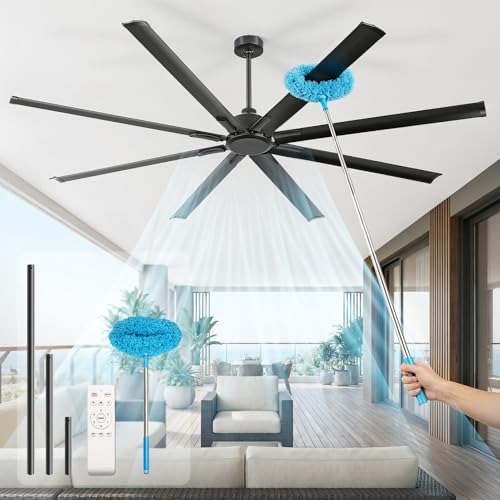
FengMang 84-Inch Industrial Ceiling Fan, 8 Blades, 6-Speed Remote, Black
More Details On Our Top Picks
Spreading a single large fan across a warehouse or oversized two-car garage creates a broader sweep than a compact household model. This 120-inch FengMang uses an HVLS design, meaning high-volume, low-speed airflow, with six aluminum blades moving air across a substantial footprint.
The DC motor reverses direction, and a timer adds scheduling convenience for shops that empty out after closing. Compared with the 120-inch silver model, this version feels more at home in a garage with a bold black finish, though both need substantial ceiling clearance and a secure mounting point.
Strengths Worth Knowing
- The 120-inch diameter suits warehouses, barns, gyms, and large commercial garages.
- Six aluminum blades provide broad movement without a household-style decorative housing.
- The reversible direct-current motor supports seasonal airflow direction changes.
- A timer helps keep airflow running during fixed work or storage schedules.
- Three downrods provide some flexibility for setting the fan below the ceiling.
Trade-Offs To Consider
- The 120-inch span demands generous room dimensions and careful blade clearance.
- Such a large fan is a more involved installation than a 22-inch or 52-inch household model.
Key Specs
Built With In Mind
This model fits warehouses, workshops, barns, and oversized garages with adequate structural support and ceiling clearance.
Another Choice May Suit
The FengMang 84-Inch Industrial Ceiling Fan suits large rooms and mid-size garages where a 120-inch span would be difficult to accommodate.
A 96-inch fan fills the awkward middle ground between a household fixture and a 120-inch warehouse model. This FengMang carries eight aluminum blades, giving it a broad visual profile suited to large shops, gyms, garages, and covered patios.
Remote operation is useful in a busy workspace because airflow can be changed without reaching for a pull chain. Compared with the 120-inch FengMang, the smaller diameter eases spatial demands while retaining a reversible DC motor and six speed settings.
Points In Its Favor
- Eight blades create a substantial, even-looking sweep across the room.
- The remote control makes frequent speed adjustments more convenient.
- A reversible DC motor gives the fan seasonal airflow options.
- The 96-inch size is more manageable than 120-inch alternatives.
Practical Considerations
- Ceiling height, joist position, and blade clearance need checking before installation.
- Three included downroods offer mounting options, though the total hanging length depends on the ceiling.
Feature Snapshot
Who It Suits Best
This model suits owners of large shops, gyms, garages, and covered outdoor areas that need substantial airflow with a manageable ceiling span.
A Better Fit Elsewhere
The FengMang 120-Inch HVLS Ceiling Fan better fits warehouses and barns where maximum diameter matters more than installation flexibility.
Silver blades give this 120-inch fan a more industrial workshop appearance than the black FengMang alternative. The six reinforced aluminum blades suit shops, garages, gyms, and patios where a large light-colored fixture will coordinate more readily with metal roofing and bright ceiling structure.
I like the remote control here because daily operation does not depend on a wall-mounted switch. It shares the same broad 120-inch format and reversible DC motor as the black model, but control method and finish create a meaningful difference in daily use.
Useful Touches
- Remote operation makes six-speed airflow adjustment more accessible.
- The silver finish blends naturally with exposed workshop and warehouse interiors.
- Six aluminum blades suit wide spaces that need substantial air movement.
- The reversible motor allows the direction of circulation to be changed.
- Three downrods provide multiple hanging positions for the housing.
Worth Noting
- The 120-inch blade diameter requires a large room and careful clearance planning.
Made For
This fan suits commercial workshops, large garages, gyms, and covered patios with substantial ceiling area and mounting support.
Look Elsewhere When
The FengMang 96-Inch Industrial Ceiling Fan is a better fit for large areas where a 120-inch diameter is excessive.
A 52-inch ceiling fan feels more natural in a converted garage, bonus room, or covered sitting area than the industrial models. The Auletta adds a light and a white contemporary finish, giving it more of a residential appearance while retaining a reversible motor.
Dual mounting options offer more placement flexibility, and dual-finish blades help the design work with changing light and color schemes. Compared with the Glenmont, the Auletta leans contemporary rather than farmhouse, which makes it a stronger fit for a bright office or finished garage workspace.
A Strong Showing
- The integrated light makes the fan useful in rooms that also need overhead illumination.
- Dual mounting options provide more flexibility for different ceiling positions.
- Dual-finish blades can complement both light and darker surroundings.
- Pull-chain controls keep operation straightforward for a residential setting.
- The reversible motor allows seasonal direction changes.
Things To Consider
- The 52-inch diameter calls for more space than the compact Briarwood and Valdosta models.
- A light-equipped fixture offers less flexibility than a fan-only industrial model.
Quick Facts
Right Fit For
This model suits converted garages, home offices, sunrooms, and other finished spaces that benefit from airflow and a light in one fixture.
Where A Sibling Pick Shines
The Prominence Home Glenmont fits traditional interiors better because its five blades, bronze finish, and LED light emphasize farmhouse styling.
The Briarwood solves the opposite problem from the 120-inch industrial fans: fitting airflow into a compact space. Its 22-inch diameter, three blades, and open-frame shape suit a small workshop alcove, covered patio, bedroom, or bonus room where a large fan would feel visually overpowering.
The matte black finish gives it a farmhouse and rustic character, yet the open cross-brace frame keeps the look light. Compared with the 52-inch Prominence Home models, it is easier to place in a modest room, though its smaller blade span naturally suits a narrower area.
Notable Upsides
- The 22-inch size fits compact ceilings and smaller work areas.
- Three blades create a familiar farmhouse silhouette.
- The matte black open-frame design adds character without a bulky housing.
- Indoor and outdoor positioning makes it useful in several covered spaces.
Small Caveats
- The compact diameter is better for a small area than for moving air across a full warehouse.
- Three-blade styling creates a more traditional look than the modern industrial designs.
- Ceiling clearance and mounting location should be checked before a low-profile fixture is chosen.
The Right Fit
This fan suits compact workshops, small patios, bedrooms, and bonus rooms where traditional styling and a modest footprint matter.
Consider Something Else When
The Allen & Roth Valdosta offers a more deliberately outdoor-focused configuration with a wet-location style and three-speed control.
Five broad blades give the Glenmont a substantial farmhouse profile, while the oil-rubbed bronze finish and LED light make it feel more like a deliberate room fixture than workshop equipment. It works well in a converted garage, dining room, den, or medium-to-large bedroom.
Three mounting options offer more installation choices than the smaller residential models, and the reversible motor changes the circulation direction. At 52 inches, it matches the Auletta’s broad residential scale, but the five-blade layout and darker finish pull it toward traditional décor.
Everyday Advantages
- Five blades provide a full, traditional farmhouse appearance.
- The LED light adds useful illumination without a separate fixture.
- Three mounting options accommodate more ceiling positions.
- Dual-finish blades work with both light and dark room palettes.
- The 52-inch size is stated for rooms up to 400 square feet.
- A reversible motor supports seasonal airflow direction changes.
Points To Note
- Pull-chain controls require manual adjustment from the room.
- The oil-rubbed bronze finish suits traditional spaces better than modern or utilitarian décor.
The Numbers That Matter
Who Should Grab It
This model suits traditional homes, converted garages, and dining or living spaces up to 400 square feet where a farmhouse fixture and LED light are desired.
Reach For A Different Pick When
The Prominence Home Auletta is the better fit for a contemporary white room that needs pull-chain controls and a cleaner modern profile.
The Valdosta brings a more explicitly outdoor approach to the compact end of the roundup. Its wet-location style, oil-rubbed bronze finish, and 20-inch frame suit a covered patio, porch, or sheltered garage entrance where moisture exposure is a practical concern.
Three cinnamon blades and a 24-degree pitch are designed to move air efficiently, with airflow listed at 3,030 cubic feet per minute on high. That figure, a volume measurement of air moved per minute, sounds impressive, but the compact 20-inch span still points toward a smaller outdoor area rather than a large garage.
Noteworthy Benefits
- The wet-location style is designed for exposed outdoor settings.
- A three-speed motor offers straightforward airflow adjustment.
- The 24-degree blade pitch supports substantial air movement.
- High-speed airflow is listed at 3,030 cubic feet per minute.
- The included four-inch downrod simplifies a standard hanging setup.
Possible Compromises
- The non-reversible motor cannot change airflow direction seasonally.
- The 20-inch size is less suited to a full garage than the industrial FengMang models.
Whose Shelf It Belongs On
This model belongs in covered patios, screened porches, small outdoor rooms, and sheltered garage entrances with a compact ceiling area.
Swap It Out When
The Progress Lighting Briarwood is a better fit for a compact interior space that favors farmhouse styling and an open-frame appearance.
An 84-inch fan is a sensible middle size for a large living room, workshop, or two-car garage where 96 and 120 inches would make placement more difficult. Eight aluminum blades give this FengMang a broad industrial profile without making it the largest model in the group.
The reversible DC motor and six-speed remote make this a comfortable everyday selection for a space used for work or relaxation. Compared with the 96-inch model, it gives up some diameter but may fit a ceiling with a little less breathing room.
Real-World Strengths
- The 84-inch diameter fits large rooms without the reach of a 120-inch fan.
- Eight aluminum blades support broad, HVLS-style air movement.
- Six speed settings allow airflow to match different activities.
- The remote control simplifies changes in a workshop or garage.
- The reversible DC motor allows seasonal direction changes.
- The black finish coordinates with many utilitarian interiors.
Details To Watch
- Blade clearance from walls, racks, and parked vehicles needs careful checking.
- Three downrods provide mounting choices, but the complete hanging height depends on the ceiling.
Core Details
Best Suited To
This fan suits large multipurpose rooms, workshops, and mid-size garages that need remote-controlled airflow without a 120-inch span.
Where Another Pick Suits Better
The FengMang 96-Inch Industrial Ceiling Fan better fits a warehouse or oversized garage where extra blade diameter is worth the greater spatial demand.
Garage Ceiling Fan Size And Setup
Match The Diameter To The Space
Blade diameter determines the area a fan can serve, but a larger fan is not automatically easier to place. The 120-inch models suit warehouses and oversized garages, the 84- and 96-inch versions handle large rooms and commercial spaces, and the 20- and 22-inch options belong in compact areas. I account for blade clearance, ceiling height, and nearby shelving before selecting a diameter.
Decide Which Controls Matter
A remote control makes sense in an active shop where changing speed from across the room adds convenience. Pull chains remain straightforward in residential rooms, while a timer helps maintain airflow during fixed schedules. Reversible motors add seasonal control, although that feature is less relevant to a non-reversible outdoor fan used only for warm-weather circulation.
Check Mounting Before Ordering
Downrods help set the fan’s hanging height, but the mounting point must align with the ceiling structure. Large aluminum fans also require more installation attention than compact household models. I check joist position, available clearance, electrical access, and the included mounting pieces before making a final selection.
What Counts Before The Final Selection
Mistakes Worth Dodging
The most common error is choosing diameter before measuring the room, especially in a garage with racks, vehicles, or a door track. Another mistake is assuming a light-equipped residential fan will cover the same area as an industrial model without a light. Control style and downrod length also deserve attention before ordering, since both affect daily convenience and installation planning.
What Separates Premium From Basic
The higher end of this category adds blade count, reversible DC motors, remote controls, or larger diameters that support broader air movement. Those features matter in warehouses, workshops, and frequently used garages, while a small covered patio may need little beyond a suitable frame and outdoor-rated construction. The extra capability is most useful when the space genuinely requires it.
Frequently Asked Questions
How Big Should A Garage Ceiling Fan Be?
The right size depends on room dimensions, mounting height, and obstacles near the blades. Compact models suit smaller spaces, while 84-, 96-, and 120-inch fans cover progressively larger areas.
Do Garage Ceiling Fans Need A Light?
A light is optional because industrial and outdoor models often focus on airflow alone. Light-equipped residential designs are useful in finished rooms that also need overhead illumination.
What Is The Difference Between DC And AC Motors?
A DC motor uses direct current and can support reversible airflow on several models. An AC motor uses alternating current and may offer fewer directional options, depending on the design.
How Do Downrods Affect Ceiling Fan Height?
Downrods connect the motor housing to the ceiling and determine how far the fan hangs below it. The correct selection depends on ceiling height, mounting position, and the required clearance above vehicles or work surfaces.
Can A Garage Ceiling Fan Be Used On A Patio?
Models labeled for outdoor or wet-location use suit covered patios and porches better than household-only fans. Exposure, ceiling protection, and local installation requirements should be checked before mounting an outdoor fixture.
Final Verdict
The FengMang 120-inch models serve the largest workshops, while the 84- and 96-inch versions make more sense for moderately sized garages. For smaller covered spaces, the compact residential and outdoor options offer easier placement and a more familiar appearance, with the right model depending mainly on space, control preferences, and mounting conditions.