
A bedside fan has to work quietly, fit a crowded nightstand, and send air where I actually sleep. I use these small circulators in bedrooms, dorm rooms, and home offices, where a bulky fan would take up more space than it earns. The eight options below range from compact personal models to feature-rich circulators with remote and app control.
A Quick View Of The Lineup

IRIS USA WOOZOO Mini Fan White

DREO 11-Inch Table Air Circulator Fan 20 dB 3 Speeds
DREO 13-Inch Oscillating Table Air Circulator Fan Remote

Bistfy 5.5-Inch Ultra-Silent Table Fan with Digital Display Rechargeable

Vornado VFAN Mini 2-Speed Metal Desk Fan Storm Gray

DREO 11-Inch Table Air Circulator Fan with Remote 8-Hour Timer

DREO Smart 12-Inch Table Fan App Voice Control 9 Speeds
DREO 12-Inch Table Air Circulator Fan 70 ft Airflow
A Closer Look At Each Pick
My first consideration was whether the fan would leave room for a lamp, phone, and water glass. At 6.70 by 4.94 by 8.27 inches, the WOOZOO Mini answers that practical concern neatly, and its built-in handle makes moving it between a desk and nightstand simple.
The 3.9-inch deep-pitch blades are intended to move air across an area up to 108 square feet. That sounds useful for a studio or small bedroom, although I would still expect the felt breeze to remain concentrated near the head of the bed. Its low 27 dB operation and three speeds make it especially appealing for light sleepers.
A Few Highlights
- Three speeds range from a gentle breeze to stronger circulation.
- The 112-degree tilt and oscillation help spread airflow across the bed.
- Its two-pound weight and carrying handle simplify room-to-room use.
Small Caveats
- The compact size suits personal airflow rather than large-room distribution.
Quick Facts
Made For
I recommend this model for small bedrooms, dorm rooms, and narrow desks where every inch of surface space matters.
Consider Something Else When
The DREO 11-Inch Table Air Circulator Fan 20 dB 3 Speeds suits me better when broader room circulation matters more than a small footprint.
This DREO model takes a different approach from the WOOZOO Mini, prioritizing more substantial airflow and a 120-degree tilt. The turbine-style design is rated at 800 CFM, meaning 800 cubic feet of air per minute, which gives it more room-moving potential than a personal desk fan.
At 20 dB, the lowest setting is quiet enough for my bedside table, and the three-speed control keeps the adjustment process simple. It measures 11.02 by 6.73 by 10.83 inches, so the extra body may crowd a very small nightstand, but it feels more balanced in a typical bedroom.
Well-Handled Touches
- Three speeds cover both gentle personal airflow and stronger circulation.
- A 120-degree tilt helps redirect air without repositioning the entire unit.
- Quiet operation suits reading, desk work, and nighttime use.
- The 11-inch format provides a larger grille than the compact WOOZOO model.
Practical Considerations
- The larger housing takes more nightstand space than the WOOZOO Mini.
- Its stated 60-foot reach may feel modest in a large, open bedroom.
Feature Snapshot
Right Fit For
I see this model as a strong match for light sleepers who want a conventional bedroom fan with a relatively quiet motor.
Another Choice May Suit
The Bistfy 5.5-Inch Ultra-Silent Table Fan with Digital Display Rechargeable is the better fit for cordless use and limited surface space.
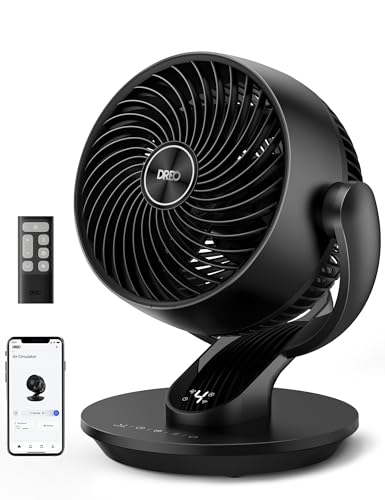
Where the 11-inch DREO model aims at a typical bedroom, this 13-inch version looks more suitable for moving air through a larger space. Its 900 CFM airflow volume, 75-foot reach, and 120-degree tilt give it greater circulation potential, especially in an open bedroom or home office.
The remote control is a meaningful bedside convenience because the four speed settings become easier to manage after lying down. At 25 dB, the fan remains quiet, although the 13.19-inch height and 11.46-inch width could feel substantial beside a bed.
Useful Strengths
- Four speeds provide finer control across different room temperatures.
- Remote operation removes the need to reach across a dark room.
- The 75-foot reach supports use in larger bedrooms and offices.
- A 120-degree tilt helps cover a broad sleeping area.
Things That May Matter
- The larger body needs more room than a personal bedside fan.
- Remote-dependent adjustments may be less convenient during a power interruption.
Who Will Love This
I recommend this model for larger bedrooms, shared offices, and anyone who values remote control over a compact footprint.
Reach For A Different Pick When
The DREO 11-Inch Table Air Circulator Fan with Remote 8-Hour Timer is more suitable for a nightstand where footprint and scheduling matter more than maximum reach.
The Bistfy fan is the smallest option here, and that changes the practical decision more than the specifications alone. Its 5.5-inch format suits a crowded bedside table, while USB recharging removes the need for a wall outlet beside the bed.
The digital display gives the four-speed control a more deliberate feel, and a brushless DC motor helps support the stated sub-30 dB operation. The fan oscillates 120 degrees and its head tilts 90 degrees, so I would expect it to work well for focused personal airflow rather than complete room circulation.
Reasons It Performs
- Rechargeable operation makes it useful in rooms with few outlets.
- The digital display provides a clear view of the selected speed.
- Wide oscillation and head tilt reduce the need for manual repositioning.
Details To Watch
- The compact size is suited to nearby airflow, not broad room distribution.
- Rechargeable operation makes the fan less convenient for continuous all-day use than a corded model.
Technical Notes
Built With In Mind
This model suits dorm residents, travelers, and anyone working from a compact desk with limited outlet access.
Skip It When
The Vornado VFAN Mini 2-Speed Metal Desk Fan Storm Gray is the better choice for a workspace that values metal construction over cordless operation.
After several plastic-bodied models, the Vornado VFAN Mini stands apart with its metal housing and understated Storm Gray finish. That makes it feel less like a temporary appliance and more like a permanent part of a desk or bedside arrangement.
Its 7.1 by 8.4 by 5.9-inch footprint remains compact, and the two speed settings keep operation straightforward. I see it as a personal cooling fan rather than a room circulator, with adjustable tilt providing enough directional control for a desk or pillow-side setup.
The Good Stuff
- Metal construction gives the fan a more substantial appearance.
- The two-speed control is easy to understand during nighttime use.
- Its compact dimensions suit desks, dorm rooms, and small shelves.
Less Ideal Details
- Two speeds offer less adjustment than the four- and nine-speed models.
- The personal airflow format may not satisfy a larger, open room.
The Right Fit
I favor this model for a tidy office, dorm room, or bedside table where visual design matters as much as basic airflow.
Where Another Pick Shines
The DREO Smart 12-Inch Table Fan App Voice Control 9 Speeds is the better fit for a connected home with several rooms and more precise scheduling needs.
This DREO model combines several bedside conveniences without expanding into the larger 13-inch format. The remote, four speeds, and eight-hour timer make daily operation easier, especially once the fan is positioned near the head of the bed.
Its 750 CFM airflow volume and stated 65-foot reach provide solid room circulation, while 25 dB operation keeps the fan unobtrusive. The housing measures 10.71 by 8.35 by 11.81 inches, which remains manageable on a normal nightstand.
A Strong Showing
- The remote simplifies speed changes from bed.
- An eight-hour timer reduces the need for manual shutdown.
- Four speeds allow airflow to be matched to different comfort levels.
- Vertical tilt and horizontal oscillation spread air around the room.
Possible Compromises
- The timer and remote add functions that may be unnecessary in a small room.
- Its reach is shorter than the 75- and 85-foot options in this lineup.
Core Details
Who Should Grab It
I recommend this fan for anyone who wants remote and timer control without moving up to a larger whole-room model.
A Better Fit Elsewhere
The DREO 13-Inch Oscillating Table Air Circulator Fan Remote offers greater reach for anyone working in a larger bedroom or office.
App and voice control make this the most connected bedside option here. I can see the appeal in a home office or dorm where I might change airflow from another room, though the extra control options only matter when the supporting setup is part of the routine.
The fan delivers up to 950 CFM with a stated 85-foot reach, giving it more circulation capability than the 11-inch DREO models. Vertical and horizontal oscillation broaden the coverage, while nine speeds and 8- or 12-hour timers provide unusually fine control for a desk or bedroom fan.
Positive Takeaways
- App and voice control support convenient remote adjustment.
- Nine speeds allow airflow to be tailored more closely to personal comfort.
- Two timer options suit different sleep and work schedules.
- Two-axis oscillation helps distribute air through a wider area.
Factors To Consider
- The smart functions add complexity for anyone who prefers basic buttons.
- The 12.2-inch height is less suitable for a very cramped nightstand.
Made For
This model suits connected homes, shared offices, and dorm residents who already use app-based controls.
Look Elsewhere When
The DREO 12-Inch Table Air Circulator Fan 70 ft Airflow is a better fit for anyone who wants broad circulation without app or voice setup.
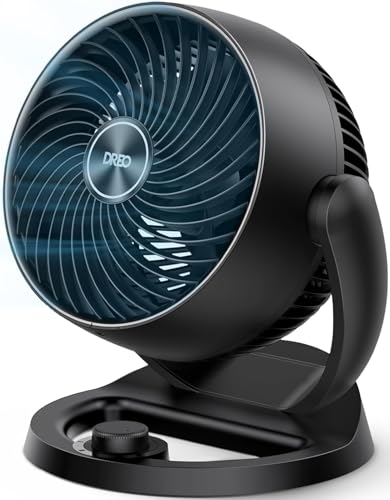
The final DREO model sits between the compact personal fans and the feature-heavy 13-inch circulator. Its 70-foot reach, 25 dB operation, and 120-degree tilt form a useful middle ground for a bedroom, home office, or kitchen counter.
Three speeds make the controls less granular than those of the smart model, but the simplicity may be welcome beside a bed. At 10.8 by 9.5 by 11.8 inches, the fan needs a moderate surface area, and the 7-inch blade helps it handle more than a basic personal breeze.
What Earns Its Place
- The 70-foot reach suits a standard bedroom without requiring a large floor fan.
- Three speeds keep everyday operation uncomplicated.
- A 120-degree tilt helps direct air toward the bed or desk.
- Quiet 25 dB operation supports sleep and focused work.
Trade Offs To Consider
- Three speeds provide less control than models with four or nine settings.
- The unit has no remote, so adjustments happen at the base.
Essential Details
Best Suited To
I recommend this model for everyday bedroom and office use where quiet operation and moderate reach matter more than smart controls.
Swap It Out When
The Bistfy 5.5-Inch Ultra-Silent Table Fan with Digital Display Rechargeable is the better fit for cordless placement and a very small surface.
What Matters Most For Bedside Comfort
Noise level comes before maximum airflow
A bedroom fan that feels powerful but distracts at night may be less useful than a quieter model. I pay close attention to the stated dB level, which measures sound in decibels, and usually start with the lowest speed during sleep. The WOOZOO Mini and the 11-inch DREO circulator make the most sense for that priority.
Footprint determines whether a fan stays out
I also measure the available bedside area before considering a larger model. A fan that crowds a lamp and a glass of water may be moved to the floor, where its airflow is less useful. Compact models such as the Bistfy and Vornado VFAN Mini suit narrow surfaces better than the 12- and 13-inch DREO options.
Controls should match real routines
A remote, timer, display, app, and voice control are useful only when they simplify regular use. The 8-hour timer handles a normal night’s sleep, while the smart model supports more flexible schedules. For a dorm or small office, a three-speed fan with simple buttons may be less distracting than a connected appliance.
Airflow reach depends on room size
Long reach can help a bedroom feel more evenly ventilated, but it doesn’t make a fan suitable for every space. I use the 60-foot 11-inch DREO for a conventional room and consider the 75- to 85-foot versions for larger layouts. Personal fans remain better for close-range cooling near a desk or pillow.
Two Details Easy To Overlook
Wrong Turns To Avoid
The most common mistake is judging airflow only by blade size or speed count. Direction matters just as much, so I check tilt and oscillation next. I also measure the nightstand before ordering because a compact listed height may still have a wide base or a handle that crowds nearby objects.
When Paying More Pays Off
A higher-tier model earns its place through scheduling, remote adjustment, stronger circulation, or smart-home compatibility. The added cost makes more sense for a large bedroom, a home office used throughout the day, or a household that values app and voice controls. For a compact personal fan, those extra functions may remain untouched.
Frequently Asked Questions
What is the quietest bedside fan in this lineup?
The DREO 11-Inch Table Air Circulator Fan 20 dB 3 Speeds and the DREO Smart 12-Inch Table Fan App Voice Control 9 Speeds each list a 20 dB operating level. The smart model adds scheduling and app controls, while the 11-inch version keeps the setup simpler.
Which bedside fan takes up the least space?
The Bistfy 5.5-Inch Ultra-Silent Table Fan with Digital Display Rechargeable is the smallest model at 5.5 inches. The Vornado VFAN Mini is also compact, but its metal housing has a broader, deeper shape.
Which option is best for a large bedroom?
The DREO 13-Inch Oscillating Table Air Circulator Fan Remote offers 900 CFM airflow and a stated 75-foot reach. Its size and remote make it more practical for a large room than a compact personal fan.
Do I need a remote control?
A remote is useful after lying down or working at a desk, particularly with multiple speeds. The DREO 11-Inch Table Air Circulator Fan with Remote 8-Hour Timer offers remote adjustment and scheduling, while simpler models keep every control on the base.
Is a louder fan better for cooling?
Greater airflow can move more air across a room, but bedside use requires a balance between circulation and sound. I prefer a lower noise level and moderate speed at night, then increase the setting only when the room needs stronger movement.
Final Thoughts
The most useful bedside fan is the one that fits the nightstand, stays quiet, and directs air toward the bed. I favor the IRIS USA WOOZOO Mini Fan White for tight spaces, the DREO 11-Inch Table Air Circulator Fan with Remote 8-Hour Timer for practical bedroom control, and the DREO Smart model for connected routines. Choosing around the actual room and sleeping habits leads to the least frustrating result.