
A bedside clock has to do two jobs well: wake the household and remain easy to read at night. I focus on large displays, ceiling projection, dimming controls, silent movement, compact footprints, and practical features such as night lights because each one solves a different problem in a bedroom.
The right choice depends on the sleeping arrangement. Some people need digits visible across the room, while others prefer a quiet analog face, a clock that tucks beneath a television, or one that projects the time onto the ceiling. The eight options below cover those distinct needs without pretending every bedroom requires the same type of clock.
The Shortlist At A Glance
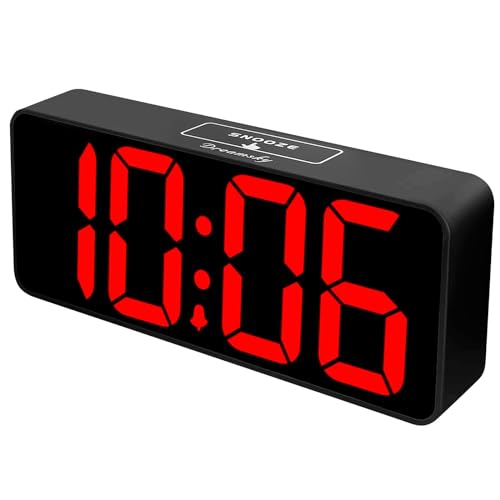
DreamSky Large Digital Alarm Clock

Lamisola Projection Alarm Clock

Lamisola White Mirror Alarm Clock

Lamisola Gold Projection Alarm Clock

Lamisola Black Projection Alarm Clock

Netzu 2-in-1 Alarm Clock

Tetano Retro Green Metal Alarm Clock with Silent Night Light

Lamisola 4.5-Inch White Silent Analog Alarm Clock with Night Light
For a bedroom shared by older adults, I look first at digit size and contrast. The DreamSky clock uses 3-inch illuminated LED numerals, giving people more room to identify the time than a conventional compact clock would provide.
Its brightness wheel is another meaningful detail for nighttime use. A setting range from 0 to 100 lets each household tune the display rather than choosing between a glaring face and a completely dark clock.
Benefits That Matter
- Three-inch digits improve visibility from across a bedroom.
- Continuous brightness control supports both daytime and nighttime use.
- The large display reduces the strain of leaning over a small clock.
Things To Consider
- Because the clock is electric, a nearby outlet becomes part of the bedside setup.
- The prominent display may feel visually bold in a minimalist room.
Key Specs
Who It Suits Best
Older adults, people with reduced vision, and households that value one clearly readable bedside display benefit most from this design.
A Better Fit Elsewhere
The Lamisola 4.5-Inch White Silent Analog Alarm Clock with Night Light suits a tiny nightstand better when minimal footprint matters more than oversized numerals.
Projection changes the bedtime routine because the time can be placed on the ceiling instead of requiring someone to turn toward the nightstand. This Lamisola model adds a 180-degree rotating projector, dual alarms, and bedside charging ports to that central feature.
Compared with the DreamSky Large Digital Alarm Clock, the display grows to 7.3 inches and gains projection. That makes this a stronger fit for a spacious bedroom where the clock sits far from the bed, though it takes more visual and physical room than a compact model.
What Makes Sense
- The rotating projector can direct the time toward a wall or ceiling.
- Dual alarms suit couples or separate weekday and weekend schedules.
- Bedside charging ports reduce the need for a separate charging setup.
- Six brightness levels accommodate darker sleeping environments.
Worth Noting
- Projection requires an unobstructed surface and a workable viewing angle.
- Charging-port compatibility should be checked against the intended devices and cables.
Feature Snapshot
Made For
Couples, teens, and anyone who wants to read the ceiling without reaching for a phone or turning toward the nightstand.
Consider Something Else When
The DreamSky Large Digital Alarm Clock offers a more focused solution for people who need large numerals but do not require projection.
The white mirror finish gives this Lamisola model a lighter presence than the black and gold projection clocks in the roundup. I find that distinction useful in a teen bedroom, dorm, or guest room where the clock needs to coordinate with pale furniture and reflective decor.
The underlying performance matches the black Lamisola Projection Alarm Clock closely: a 7.3-inch LED face, six brightness settings, dual alarms, a rotating projector, and bedside charging ports. The finish is the main decision point rather than a shortcut around the core features.
The Practical Payoff
- The white mirror finish complements lighter bedroom decor.
- Large projected digits support reading without approaching the clock.
Trade Offs
- The 7.3-inch body occupies more space than a small analog alarm clock.
Best Suited To
People decorating a bright bedroom who value coordinated styling alongside projection and adjustable display brightness.
Where A Sibling Pick Shines
The Tetino Retro Green Metal Alarm Clock with Silent Night Light offers a quieter analog alternative for bedrooms where ticking and electronic displays are undesirable.
The gold version makes alarm volume the decisive feature. Five settings spanning 55 to 95 decibels give households a wider range than the DreamSky clock, which focuses primarily on display visibility rather than documented sound control.
I would pay attention to this model in a shared room where one person needs a stronger alarm and another prefers a gentler wake-up. The 7.3-inch mirror display, six brightness levels, full screen-off mode, ceiling projection, dual alarms, and charging ports cover the broader bedside needs.
The Value In It
- Five alarm levels support different waking preferences.
- A documented 95-decibel maximum suits people who struggle with gentler alarms.
- Full screen-off mode darkens the bedside display completely.
- The rotating projector allows ceiling viewing from the bed.
- Gold coloring adds warmth to neutral or traditional rooms.
Minor Gripes
- The lowest setting may still be inadequate for a very heavy sleeper, so the sound should be judged in the actual bedroom.
At A Glance
Built With In Mind
Heavy sleepers and shared bedrooms benefit from the documented volume range and separate control over screen brightness.
Another Choice May Suit
The Lamisola Projection Alarm Clock is a better fit for a darker room because its black finish carries less visual warmth than this gold model.
Black suits bedrooms with darker furniture, industrial accents, or a restrained color palette. Unlike the gold Lamisola model, this version feels visually quieter, but it retains the same useful combination of projection, adjustable alarm volume, and a large mirror-style display.
That combination makes it a flexible middle ground between a simple bedside clock and a dedicated projection model. The practical question becomes placement: a clear ceiling or wall helps the projected time work, while the 7.3-inch body still needs a stable surface nearby.
Advantages To Know
- Five volume settings accommodate different sleep patterns.
- Six display brightness levels include a screen-off mode.
- The black finish coordinates easily with darker bedroom furniture.
Potential Drawbacks
- The large display takes up more room than a small analog clock.
- Sound level may still need adjustment in a shared room.
- Ceiling projection depends on a clear surface and correct positioning.
The Right Fit
People wanting a dark bedside clock with adjustable sound and ceiling viewing benefit from this balanced feature set.
Swap It Out When
The Lamisola White Mirror Alarm Clock suits a pale room better, while the Netzu 2-in-1 Alarm Clock serves a compact television stand more effectively.
The clearest reason to consider the Netzu clock is placement. Its slim body is designed to slide beneath a television, filling the narrow space often left unused below a screen or streaming device.
That approach feels more natural in a living room, dorm, or home office than on a traditional nightstand. For a bedroom with limited shelf space, the compact format may prevent the clock from becoming another crowded object beside the bed.
What Pays Off
- The slim body fits beneath televisions where larger clocks cannot.
- Its compact form preserves useful shelf and stand space.
Points To Note
- Under-TV placement is less useful when no television occupies the bedroom.
- Those wanting ceiling projection should favor one of the larger Lamisola models.
Quick Facts
Whose Shelf It Belongs On
Small-space homes, dorm rooms, and entertainment centers benefit most from the low-profile placement.
Reach For A Different Pick When
The Lamisola 4.5-Inch White Silent Analog Alarm Clock with Night Light serves a traditional bedside table better than a television stand.
For a bedroom that feels too filled with electronics, the Tetino clock offers a quieter change in character. Its analog face, green metal body, and simple styling suit a nightstand, desk, or retro-inspired room.
The important practical detail is the silent movement. Without the repeated tick of a mechanical clock, the room stays visually calm and acoustically restrained, which can be preferable for light sleepers or anyone sensitive to repetitive background noise.
The Helpful Details
- Silent movement avoids the repeated ticking of a mechanical clock.
- The green metal finish adds a distinctive retro accent.
- Battery operation keeps the clock usable without a bedside cord.
Small Caveats
- Analog reading takes more concentration than large illuminated numerals.
- Battery-powered operation requires periodic battery replacement.
Who Should Grab It
Quiet bedrooms, retro interiors, and people avoiding glowing displays benefit from this straightforward analog design.
Look Elsewhere When
The Lamisola Projection Alarm Clock provides a better answer for large or distant viewing when the projection feature is the priority.
A 4.5-inch clock is small enough for a narrow nightstand, a dorm shelf, a vanity, or a travel bag. I appreciate that this Lamisola model retains an analog face and silent movement rather than forcing a bright digital display into every bedroom.
The night light provides brief bedside orientation, staying on for four seconds before switching off. Compared with the Tetino clock, the stated diameter makes the space-saving advantage much easier to judge before placing it on a shelf.
Everyday Perks
- The 4.5-inch body fits compact bedside and desk spaces.
- Silent movement avoids repetitive ticking in the room.
- Battery operation supports portable placement without a cord.
- The brief night light helps with orientation after waking.
Things That May Matter
- The compact face may be harder to read than a jumbo digital display.
- The four-second night light provides guidance rather than sustained illumination.
Technical Notes
Travel Ready
Dorm residents, frequent travelers, and people with very small nightstands benefit from the portable 4.5-inch format.
Not Your Match When
The DreamSky Large Digital Alarm Clock serves households that prioritize large illuminated digits and extensive dimming over analog simplicity.
What Matters Most Before Bedside
Visibility From Bed
I start with the distance between the bed and the clock, because that determines which display style makes sense. A 3-inch or 7.3-inch digital face serves people who need a direct line of sight, while a ceiling projector removes the need to look toward the nightstand at all. The Lamisola projection models also help when reaching for a phone feels inconvenient after waking.
Sound and Light Controls
A bright display can be as disruptive as a loud alarm, so brightness and alarm volume deserve equal attention. The gold and black Lamisola clocks provide five volume levels and six display settings, including screen-off mode on the models with documented volume controls. The DreamSky clock instead concentrates on 0-to-100 brightness adjustment, making it particularly useful in darker rooms.
Power, Placement, and Style
I also check where the clock will live. A Netzu model makes sense below a television, while a 4.5-inch analog clock suits a crowded nightstand. Battery operation removes cord placement from the decision, whereas an electric clock requires access to an outlet. Finish matters too, with black, white, gold, and green each fitting a different bedroom palette.
Common Mistakes Worth Avoiding
The most common mistake is judging a clock only from its front-facing display. A ceiling projector also needs a clear surface, an adjustable angle, and enough distance to produce a readable image. Another mistake is choosing a compact face for a bed positioned far from the nightstand. The best fit comes from the room layout, not simply the smallest design.
The Upgrade Payoff
Higher-tier models often spend more on display size, sound controls, projection, charging ports, and multiple alarms. That extra capability matters in larger bedrooms, shared rooms, and homes where one device must replace several bedside functions. A small analog clock remains the sensible choice when simplicity, portability, and quiet operation matter more.
Frequently Asked Questions
Which alarm clock is easiest to read from across a bedroom?
The DreamSky Large Digital Alarm Clock offers 3-inch illuminated numerals, while the Lamisola projection models use a 7.3-inch display and can place the time on a wall or ceiling. Distance and viewing angle determine which approach works best in a particular room.
Are projection alarm clocks better than analog clocks?
Projection clocks suit people who prefer looking toward the ceiling instead of turning toward the nightstand. Analog clocks remain easier for bedrooms that favor understated decor, silent operation, and minimal electronic light.
Do bedroom alarm clocks need charging ports?
Charging ports are convenient but not essential for every setup. The Lamisola Projection Alarm Clock includes bedside charging ports, which can simplify a nightstand shared by two people with compatible devices and cables.
Which option suits a tiny bedside table?
The Lamisola 4.5-Inch White Silent Analog Alarm Clock with Night Light has a clearly stated compact diameter. The Tetino Retro Green Metal Alarm Clock with Silent Night Light also favors a small analog format, while the Netzu 2-in-1 Alarm Clock works mainly beneath televisions.
Are silent analog clocks practical for everyday use?
Silent movement removes the repetitive sound associated with a ticking mechanical clock, making it useful in quiet bedrooms. The display still needs to be large enough for the person using it, especially in a dark room or from across the bed.
Final Verdict
I would choose the DreamSky Large Digital Alarm Clock for straightforward visibility, the Lamisola projection models for ceiling viewing and adjustable alarms, and a small analog clock for quiet, compact bedrooms. The Netzu clock earns its place when space beneath a television is the real constraint. Match the clock to the room layout first, then let display size, sound, and finish settle the decision.