
A multimeter can turn an unfamiliar electrical problem into a manageable diagnosis, whether you are checking a dead outlet, testing a battery, or troubleshooting a home solar panel. It helps reveal voltage, resistance, continuity, and current without replacing the need to follow safe electrical procedures. The right choice depends on whether you need a versatile household tool or a dedicated solar diagnostic device.
The Essentials At A Glance

Crenova MS8233D TRMS Multimeter
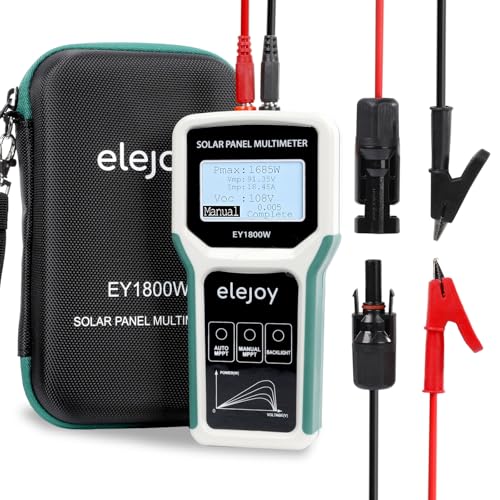
elejoy 1800W Solar Panel Tester

elejoy 400W Solar Panel Tester

elejoy 1600W Solar Panel Tester

TESMEN TM-510 4000-Count Auto-Ranging Multimeter with NCV, Green

elejoy 800W Solar Panel Tester
A Deeper Look At The Lineup
The MS8233D covers the kinds of checks most homeowners eventually need, from a flickering lamp to a battery that refuses to hold a charge. TRMS means true root mean square, a method of reading AC signals that can help with household electronics. Unlike the solar-focused devices later in this lineup, it also measures capacitance, frequency, and duty cycle.
That range makes it a practical choice for a garage, workshop, or utility closet, though a novice may take time to become comfortable with manual lead placement and function selection. You still need to disconnect power and use appropriate precautions before probing live wiring.
What Stands Out
- Auto-ranging reduces the need to select a measurement range yourself.
- Measures AC and DC voltage, current, resistance, capacitance, frequency, and duty cycle.
- Continuity and diode checks help narrow down component faults.
- NCV detection offers a non-contact way to check for energized wiring.
- Two built-in fuses add overload protection, while the rubber holster supports safer handling.
Practical Considerations
- The broad function set may feel crowded to someone making their first electrical measurements.
- Its CAT III 600V classification does not make it suitable for every electrical environment.
Feature Snapshot
Built With In Mind
Experienced DIYers handling mixed household electrical tasks benefit most from this model’s broad measurement functions.
Another Choice May Suit
The TESMEN TM-510 fits newer users better when automatic function detection matters more than capacitance, frequency, and duty-cycle readings.
This meter shifts attention from household circuits to the operating behavior of a photovoltaic panel. It locates the maximum power point, or MPPT, which is the operating point where a panel delivers its greatest measured output. The device also reports open-circuit voltage, abbreviated Voc, and short-circuit current, abbreviated Isc.
For a homeowner with several larger panels, the 1800W ceiling gives you more room than the 400W model in this group. The meter runs without batteries and comes with an EVA carrying case, so taking readings near a roof or garden array is more convenient.
Practical Pluses
- Supports panels rated up to 1800W.
- Reports power, performance, Voc, and Isc through an MPPT-oriented test.
- Battery-free operation removes one charging task during field work.
- The EVA kit helps organize the meter and connection leads.
Trade Offs
- Its solar focus makes it less useful for ordinary outlets and household wiring than a general multimeter.
- For a single small panel, the greater measurement capacity may remain unused.
Quick Facts
The Right Fit
Homeowners maintaining larger residential arrays benefit most from the generous 1800W measurement range.
Reach For A Different Pick When
The elejoy 400W Solar Panel Tester is a better fit when portability and a smaller system matter more than higher panel capacity.
At 460g, this solar tester is built for carrying between a small array and your work area. It checks 12V and 24V panels up to 400W, which covers many compact home installations. The sunlight-readable LCD is a sensible choice for outdoor work, where a darker screen can become frustrating.
Its MPPT test can help reveal output changes caused by shade, dirt, or damage, giving you evidence before opening an enclosure. Compared with the elejoy 1800W Solar Panel Tester, the trade-off is straightforward: you gain portability but lose support for larger arrays.
Positive Takeaways
- Lightweight 460g body simplifies transport to a rooftop or garden array.
- Supports both common 12V and 24V residential panel systems.
- The MPPT reading helps identify performance changes at a panel’s peak output point.
- Sunlight-readable display suits outdoor diagnostics.
Small Caveats
- The 400W ceiling excludes larger residential arrays.
- It remains a specialized panel tester rather than a general-purpose electrical meter.
Made For
Homeowners with a small 12V or 24V solar array benefit most from this lightweight, field-oriented design.
Swap It Out When
The elejoy 800W Solar Panel Tester offers a better fit for a midrange array that exceeds the 400W limit.
Roof-mounted and ground-mounted arrays can present awkward access and uneven sunlight, making portable diagnostics useful. The elejoy 1600W Solar Panel Tester measures output at the MPPT and records Voc, Isc, and panel performance. That gives a homeowner several ways to compare a panel’s behavior under actual installation conditions.
The battery-free design and included EVA kit reduce preparation before a field check. You still need panel ratings to stay within the supported 1600W ceiling, so check the label on the panel or array before connecting anything.
What Pays Off
- Handles residential arrays up to 1600W.
- Combines power, performance, Voc, and Isc readings in one field-oriented instrument.
- Operates without batteries for convenient remote diagnostics.
- The EVA kit provides a practical way to carry the tester and accessories.
Points To Note
- The 1600W limit remains below the elejoy 1800W Solar Panel Tester’s capacity.
- General outlet testing falls outside this model’s specialized role.
Technical Highlights
Who Will Love This
Homeowners performing recurring checks on sizable residential arrays benefit most from the 1600W capacity.
Look Elsewhere When
The Crenova MS8233D TRMS Multimeter suits mixed household electrical work that includes both solar and conventional circuits.
The TM-510 takes much of the guesswork out of a first home multimeter. Smart Auto Mode identifies the measurement task and range without requiring you to configure each function manually. For a new user checking a battery, outlet, or resistive component, that simpler workflow can make the first session less intimidating.
Its non-contact voltage function provides visual and audible alerts when the meter detects an energized field. That is useful for a quick initial check, though it does not replace contact testing or safe isolation procedures. Compared with the Crenova MS8233D, the TM-510 prioritizes automatic operation over the same broad set of advanced functions.
Notable Upsides
- Smart Auto Mode simplifies function and range selection.
- Measures AC and DC voltage, resistance, and continuity.
- The NCV function offers both visual and audible alerts.
- Auto-ranging reduces setup steps during routine household checks.
Things To Consider
- The listed measurement functions are narrower than those of the Crenova MS8233D.
- The 4000-count display provides less detail than the 6000-count model.
Who Should Grab It
New DIYers and occasional troubleshooters benefit most from automatic mode selection and straightforward measurements.
Where Another Pick Shines
The Crenova MS8233D TRMS Multimeter better serves experienced users who regularly measure capacitance, frequency, or duty cycle.
This middle-capacity solar tester supports panels up to 800W, covering many residential installations without approaching the capacity of larger models. Its specified voltage range reaches 60V for Voc, the voltage produced without a connected load, and 35A for Isc, the current produced under a short-circuit condition.
MPPT testing helps locate the panel’s peak operating point, which is useful when checking how shade or dirt changes output. For a moderate array, the range appears well balanced; for a very large installation, the 1600W or 1800W options provide more headroom.
Notable Gains
- Handles panels rated up to 800W.
- Supports Voc measurements from 12V to 60V.
- Supports Isc measurements from 0A to 35A.
- MPPT testing helps reveal changes in panel performance.
Where It May Fall Short
- Large residential arrays may exceed its 800W capacity.
- You need a separate general multimeter for household wiring and component checks.
Core Details
Whose Shelf It Belongs On
Homeowners with a midrange solar array benefit most from the 800W limit and detailed operating ranges.
Skip It When
The elejoy 1800W Solar Panel Tester is the better fit when your connected panels exceed the 800W ceiling.
What To Match Before Buying
Start with the jobs you expect to perform. A general-purpose meter is the more useful choice for outlets, batteries, appliance circuits, continuity checks, and unidentified components. The TESMEN TM-510 favors simple automatic operation, while the Crenova MS8233D provides a wider selection of electrical measurements for regular DIY work.
Home solar systems require a different decision. Compare the panel’s labeled power rating with the tester’s supported capacity, and check the voltage and current limits before connection. MPPT capability matters when you want to compare output at the panel’s peak operating point, while Voc and Isc readings add context during troubleshooting.
Portability can be just as important as range for rooftop or garden-array work. The 460g elejoy 400W Solar Panel Tester prioritizes easy carrying, while the higher-capacity solar models serve installations with more demanding power requirements. For most homes, matching the instrument to the equipment produces a more useful tool than simply choosing the broadest listed range.
Understand TRMS And NCV
TRMS, or true root mean square, describes how an AC measurement represents a signal. It is relevant for household electronics and loads whose output does not resemble a simple straight waveform.
NCV means non-contact voltage. It gives you an early indication of an energized field without touching the conductor, but it remains a preliminary check rather than a substitute for isolation and contact measurements.
Check The Safety Category
A multimeter’s safety category identifies the type of electrical environment in which its measurement protection is designed for use. The Crenova MS8233D is rated to CAT III at 600V, so match that limit to the circuits and panels you plan to measure rather than treating it as unrestricted access to every electrical system.
Lessons Before You Connect The Leads
Mistakes Worth Dodging
A common mistake is choosing a wide measurement range without checking the equipment’s labels. Another is treating a non-contact alert as proof that a circuit is fully de-energized.
Confirm the connection method, supported voltage or current range, and measurement category before testing. Start with the correct function and leads, then record the reading under a known condition.
When Paying More Pays Off
Higher-tier instruments add useful detail only when your tasks justify it. Advanced functions such as TRMS, capacitance, frequency, or duty cycle can support deeper component work, while a solar MPPT test adds value when diagnosing panel performance.
Extra capacity helps with larger arrays but remains unnecessary for a small setup. The practical upgrade is the feature or range that matches your actual equipment, not simply the longest specification list.
Frequently Asked Questions
Do I need a general multimeter or a solar panel tester?
A general multimeter suits outlets, batteries, and household wiring, while a solar panel tester specializes in photovoltaic measurements. You may want both tools for a mixed maintenance routine.
What does MPPT mean in a solar panel tester?
MPPT stands for maximum power point, the operating point where a panel delivers its highest measured output. It helps reveal performance changes caused by shade, dirt, or damage.
Does NCV replace contact voltage testing?
No. NCV provides a quick non-contact indication of an energized field, while contact testing gives a direct measurement after appropriate isolation and safety procedures.
Can a home multimeter test solar panel output?
A general multimeter can check basic electrical properties, but a dedicated solar tester adds MPPT, Voc, and Isc readings. Those measurements make panel performance comparisons easier to interpret.
Which specifications matter most for home use?
Measurement functions, supported ranges, safety category, portability, and compatibility with your equipment matter most. Match each specification to the actual outlets, components, or solar panels you plan to examine.
Final Thoughts
Your best choice depends on the work: the TESMEN TM-510 suits straightforward home checks, the Crenova MS8233D handles a wider electrical range, and the elejoy models serve specific solar-panel capacities. Match the tool to your system, verify the connection requirements, and let the measurements guide your next diagnostic step.